
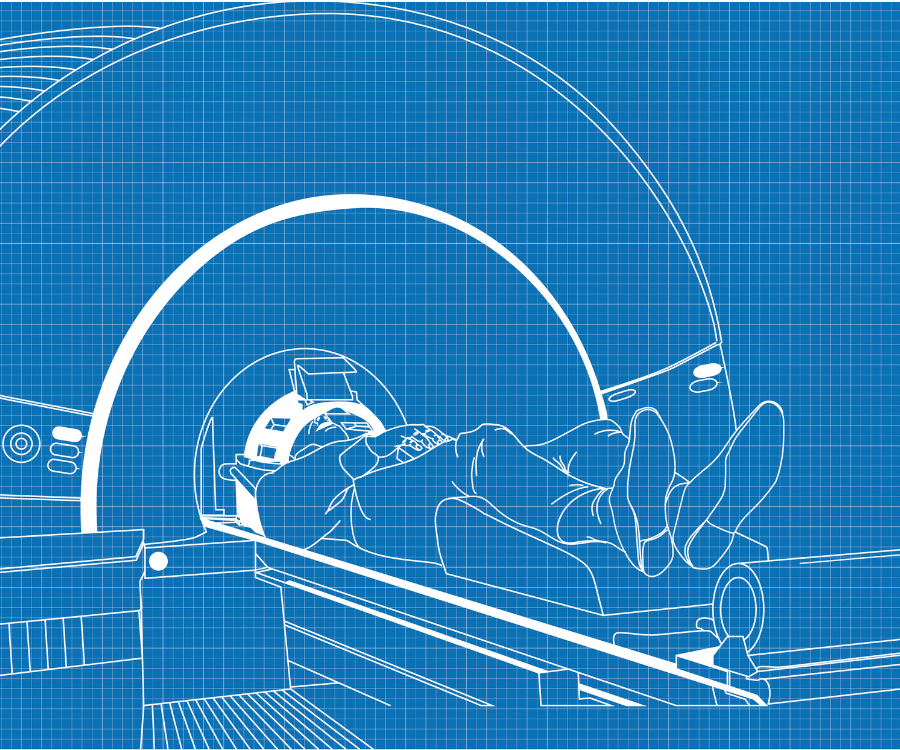
If you’ve ever had an MRI, or if you’re preparing for your first one, you already know the routine. The technician hands you a gown and asks a series of highly specific questions: Do you have any piercings? Are you wearing a watch? Is there any chance you have metal fragments in your body?
They might even wave a wand-style metal detector over you before you’re allowed anywhere near the scanning room.
It can feel a bit like high-level airport security, but there is a very good reason for the intensity. Inside that sleek, futuristic donut-shaped machine is one of the most powerful tools in modern medicine—and it runs on physics that do not play nice with metal.
Here is a look at exactly what happens inside an MRI machine, and why leaving your keys, jewelry, and even certain types of clothing outside the door is absolutely non-negotiable.
The “Always-On” Super Magnet
To understand MRI safety, you have to understand how the machine works. MRI stands for Magnetic Resonance Imaging. Unlike an X-ray or a CT scan, which uses low levels of radiation to snap a picture of your bones, an MRI uses a combination of radio waves and an incredibly strong magnetic field to map the soft tissues inside your body.
The most important thing to know about an MRI machine is this: The magnet is always on.
It doesn’t turn off when the scan stops, and it doesn’t shut down when the technician steps out of the room. It is a permanent, active force field.
To put its power into perspective, the magnetic field of a standard clinical MRI machine (measured in units called Tesla) is typically between $1.5\text{ T}$ and $3.0\text{ T}$. That is roughly 30,000 to 60,000 times stronger than the Earth’s magnetic field. It is strong enough to pull heavy metal objects across a room.
What Happens When Metal Meets the Magnet?
When a ferromagnetic object (metal that contains iron, nickel, or cobalt) enters the MRI room, the machine’s magnetic field acts on it instantly. In the medical world, this sets off three major risks:
1. The Missile Effect
This is the most dramatic and dangerous hazard. If a loose metallic object—like a pair of scissors, a clipboard, a oxygen tank, or even a smartphone—is brought into the room, it can instantly become a high-speed projectile. The machine sucks the object toward its center with terrifying speed and force. Anything or anyone standing in the path of that “missile” can be seriously injured.
2. Thermal Burns
Not all metals fly across the room, but that doesn’t mean they are safe. Certain metals can absorb the radiofrequency energy used during the scan, causing them to heat up rapidly. This is why technicians are incredibly careful about internal metal, like surgical staples, joint replacements, or old tattoos (some older tattoo inks contain iron oxides). If an unrecognized metal element gets hot during a scan, it can cause severe internal or skin burns.
3. Image Distortion (Artifacts)
Even if a metal object is perfectly safe and firmly anchored, it can warp the magnetic field immediately surrounding it. In the final image, this shows up as a massive black void or a distorted blur (known as an artifact). If the metal is close to the area your doctor needs to look at, it can render the entire scan useless, meaning you’ll have to repeat the process.
The Hidden Metals You Might Not Think About
We all know to take off our rings, belts, and watches. But modern manufacturing has introduced metal into places you’d least expect it. Here are a few hidden culprits that routinely surprise patients:
- Athletic Wear and Athleisure: Many modern workout shirts, leggings, and sports bras use “anti-microbial” silver technology. Microscopic silver threads are woven into the fabric to prevent odor. Under an MRI, these threads can heat up and cause serious skin burns. Always change into the provided medical hospital scrubs.
- Cosmetics: Some cosmetics, particularly metallic eyeshadows, mascaras, and long-wear foundations, contain trace amounts of iron oxides. These can cause a tingling, burning sensation during the scan and blur images of the brain or eyes.
- Clothing Fasteners: Tiny metal rivets on jeans, metallic zippers, or the underwires in bras can react under the scanner.
- Medical Patches: Nicotine patches, pain relief patches, or hormonal patches often have a thin metallic backing to help regulate drug delivery. If left on, they can overheat and burn the skin.
Doing Your Part for a Safe Scan
The screening form you fill out before an MRI might feel repetitive, but it is your primary line of defense.
Always be completely transparent with your imaging team. If you have any internal medical devices (like pacemakers, cochlear implants, artificial heart valves, or aneurysm clips), the team needs to verify the exact make and model. Most modern implants are engineered to be “MRI-conditional” (safe under specific machine settings), but the team must confirm this before your scan begins.
The strict rules aren’t there to inconvenince you—they are there to ensure that the incredible power of magnetic imaging is used safely, getting your doctor the clear answers they need without any unexpected fireworks.
No comment